



Founder
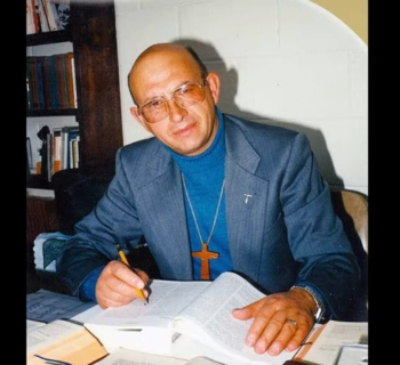
Father Luigi Butera was born on May 22, 1932, in Marianopoli, Sicily, Italy. He grew up in a family of four siblings and deeply religious parents.
At the end of 1945, at the age of 13, he entered the seminary in Caltanissetta. It was during his seminary formation that he felt a strong calling to missionary life, with a special predilection for the African continent.
In 1956, he decided to join the Comboni Missionaries and received the Sacrament of Holy Orders in the Cathedral of Milan on April 2, 1960.
He was sent to Spain, where he learned the language. Years later, he was sent to Mexico to replace a priest murdered in 1963, where he held various positions in different states of the country.
As a Catholic priest, Father Luigi Butera was aware of the urgent need to evangelize the people of God. However, he also understood the daily responsibilities of priests and how difficult it was for them to dedicate more time to this task. He reflected on a solution. In 1972, as a Comboni priest, he had the opportunity to visit Bangkok, Thailand. There, he saw young Buddhists lined up and asked them if they had a special consecration. They replied that they had served as laypeople for a year before becoming religious. Over time, the idea of training lay ministers as missionaries came to him. Later, back in Mexico, he encountered young Mormons visiting homes to share their religion and wondered, "Why don't we do something similar in the Catholic Church?" After deep and prayerful discernment, he concluded, "We must prepare Catholic laypeople to serve in missions."
In 1972, he made the decision to preach with the Bible in hand, arousing great interest among those who heard the word of God. He began to organize them, giving them some training, and sent them out to deliver the message to homes.
Who are we?
We, the Servants of the Word, are a missionary family whose motto is: “Evangelizing the laity to evangelize with the laity.” Therefore, all of us, consecrated and lay, are dedicated to evangelization, that is, to the establishment of the Kingdom of God in the hearts of those who have not yet received it, through the proclamation of the Word of God.
The Servants of the Word missionary family is comprised of:
1. The Missionaries Servants of the Word (MSP) are religious, priests, and lay brothers who constitute an Institute of Consecrated Life of Pontifical Right (2008). Currently, there are more than 300 priests, deacons, seminarians, and lay brothers in 20 countries.
2. The Sisters Missionaries Servants of the Word (HMSP) are religious sisters who constitute an Institute of Consecrated Life of Pontifical Right (2008). The sisters number over 400, spread across 20 countries.
3. The Fraternitas Verbi, who are consecrated lay people affiliated with Institutes of Consecrated Life.
4. The Servants of the Word (SP), lay people who dedicate one, two, or more years of their lives to God to serve full-time in evangelization on a voluntary basis. They leave their homes, families, and personal plans to evangelize in the parishes where they are sent.
5. The Lay Servants of the Word (LSP), a Public Association of lay faithful who dedicate themselves to evangelization after having experienced the power of the Word of God. This same group is made up of several apostolic groups: Chiquitines, adolescents Servants of the Word (ADOSEPAS), Missionary Youth (JUMI), Lay Leaders Servants of the Word (LLSP), Catholic Marriages Servants of the Word (MCSP) and Evangelizing Community for Reconciliation and Service (CERS).
“As the Father has sent me, so I send you.” John 20:21
Our Charism
We, the Missionary Servants of the Word, have a unique identity that defines our being and our work within the Church, which we call our "Charism." Jesus himself always identified himself as the one sent by the Father; we find this reference 39 times in the Gospel of John. This identification of Jesus stems from a life program beginning in his adolescence: "...You did not know that I must be in my Father's house..." (cf. Lk 2:49); later, at the beginning of his ministry, he reaffirms this awareness: "The Spirit of the Lord is upon me... he has anointed me to proclaim the Good News... he has sent me to proclaim..." (cf. Lk 4:18); in his offering on the cross: "...It is finished..." (cf. Jn 19:30); and in his resurrection, sending and being with his followers: "As the Father has sent me, so I send you" (cf. Jn 20:21). The Missionary Servant of the Word unites himself to Christ's action of proclaiming the Kingdom; therefore, our charism is centered on the person of Christ and is carried out in a concrete action: "Evangelization," which has the laity as its recipients and co-responsible parties, both in its preparation and accompaniment: "Evangelizing the laity to evangelize with the laity."
Since Revelation is the source of Sacred Scripture and the driving force behind our evangelization, the Missionary Servant of the Word is founded on the Word of God, a profound relationship with the sacred text that, more than being merely an instrument, is the direct proclamation of the voice of God.
The personal encounter and experience with the Word of God gives meaning to the slogan "He who has known God cannot remain silent" (Czo 1,97) because it leads the Missionary Servant of the Word to transmit and announce the message with a Kerygmatic preaching, a preaching that seeks to be creative and adaptive in different environments, making use of all means where it can be communicated.
Our Spirituality
“It is not easy to find a clear definition of spirituality, although much is said about the existence of different spiritualities. We speak of lay spirituality, priestly spirituality, religious spirituality… I find the expression that defines spirituality as “the dynamism of the Spirit in the life of the soul” very apt. In reality, it is about living under the impulse of the Spirit the Gospel.
To live in this dynamism of the Spirit is to have spirituality. Therefore, those who live on their own and do not allow themselves to be guided by the breath of the Spirit lacks spirituality; this is mainly due to a lack of humility and generosity. Our Lord said: “The Holy Spirit, whom the Father will send in my name, he will teach you all things and will remind you of everything I have said to you” (John 14:26).
It is this active presence of the Spirit that helps us understand and live the Gospel. Nobody can exhaust the experience of the Gospel. That is why spirituality could be defined as a way of living the Gospel under the guidance of the Holy Spirit. Throughout the Church's millennia-long history, countless religious communities have flourished, enriching the Church with different charisms. Among the most recent is the spirituality of the Missionary Servants of the Word, whose characteristic is: "To make known the power of the Word so that those who receive it, in turn, may share it with others."
Excerpts from the book: "This is how the Lord wants us" that helps us to understand and live the Gospel. No one can exhaust the experience of the Gospel. That is why spirituality could be defined as a way of living the Gospel under the guidance of the Holy Spirit. Throughout the Church's millennia-long history, countless religious communities have flourished, enriching the Church with different charisms. Among the most recent is the spirituality of the Missionaries Servants of the Word, whose defining characteristic is: “To make known the power of the Word so that those who receive it, in turn, may share it with others.” »
Our Method
We, the Servants of the Word, have our own method, implemented by our founding father, Luigi Butera MSP, which consists of evangelizing with the Bible in hand and guided by nine sequential Bible courses. This method is not an intellectual approach to the Word of God, but rather a reflection on the sacred history recorded in the Bible in order to achieve ongoing conversion, live the faith we have received, and strive for holiness.